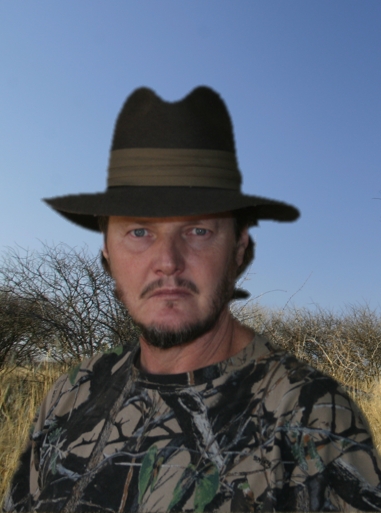
The Making of a Hunter
It was the year of 1978 when the tide of Danie van Graan’s life turned from the ivory towers of law to the hard earth of Lowveld farmland. He had just finished his BA Law at the University of Pretoria, with the dream of an LLB still ahead. But life had other plans. He took Karin as his wife and settled into the old family homestead at Stentor–a stone house shaded by ancient marulas and ghostly fever trees, the kind that whisper secrets to those who listen.
Working the land for his father was no easy matter. Nearly 20,000 acres of farmland lay beneath the burning African sun, thirsty and waiting. Danie, young and determined, took up the mantle in his father’s sprawling agricultural empire–reclaiming the land with irrigation systems that threaded through the earth like veins. A citrus factory and large packhouse roared with machinery, ripe fruit, and men shouting over conveyor belts. But the land held something more for Danie–something wild.
On the edge of this kingdom, wrapped in dense thornveld and acacia woodland, Danie and Karin carved out their dream: Engonyameni Safaris–the Place of the Lion. They built a lodge on the shores of a still, secret lake. Treehouse rooms clung to the trunks of knobthorns and wild figs, linked by wooden walkways to a bar raised high above the water.
It was Robinson Crusoe, reborn in Africa, with roaring fires and jackal calls at dusk.
To tame this wilderness, Danie called on three men–trackers whose feet could read the earth like scripture: Elmon, Robert, and Gugwana. These men weren’t hired hands. They were brothers of the veldt, part of the soul of Engonyameni. Danie always said they were the real heroes of the safari. Gugwana had a young son – barely eight years old – named Mageka.
One day, the boy stood before Danie, eyes wide, barefoot on the warm dust of the camp.
“Please give me a job, Baba (father) Danie,” he said.
“I cannot pay you, Mageka,” Danie replied.
The child shook his head. “I don’t want pay. I want to learn.”
And so it began–a bond forged in sweat and smoke and long days beneath the Lowveld sun. Mageka swept the camp, washed the vehicles, and cleaned the butchery with the diligence of a boy who knew where he was going. He walked to a nearby farm school by day and returned to sweep the yard by dusk. As the years passed, he grew strong–stronger than most boys his age. By fifteen, he could weld, rebuild engines, track kudu through dry thorn, and shoot straight and calm. He was becoming something rare.
Across the valley lived Dave Edgcumbe, Danie’s neighbour, whose son David became Mageka’s friend. The two boys–one white, one black–ran barefoot across the bushveld, laughing like hyenas and dreaming of buffalo and lions.
At sixteen, Danie found himself short of a professional hunter and Mageka volunteered. Danie hesitated. It was illegal–immensely risky–to send a teenager with just a tracker, but something in the boy’s gaze reminded him of himself at that age. He gave a quiet nod.
“Do not shame the name,” he said.
“Never,” said Mageka.

From that day, Mageka was no longer a tracker–he was an apprentice to a greater calling. But he had to learn more than how to read spoor or gut a sable antelope. He had to learn people–white people. Danie, with his heart in Africa and his tongue fluent in siSwati, was no good for that. Instead, he sent Karin and young David to teach Mageka the language and mannerisms of European guests.
Mageka began being a tracker to the wives and children–clients most PHs ignored. But Mageka used every opportunity to shine. When the guests were gone, he stalked the veldt, locating record-breaking trophies and mapping their habits, preparing for the day when his skill would be called upon. And when the time came, he delivered: kudu with spiral horns like sabres, waterbuck that stood like kings, nyala that melted into the bush before revealing themselves like ghosts.
At eighteen, Danie sent Magek on his first formal training–practical skinning, hunting, client care. In the Cape, he was meant to bunk with other black students, but when Danie and Karin returned ten days later, they found him emerging from the tent of the white trainees.
“Why?” Danie asked.
Mageka chuckled. “The others’ feet smelled too bad. I asked the white guys if I could stay with them. I offered to polish their boots and make their beds in return.”
That was Mageka–humble, resourceful, proud.
At nineteen, Danie took him to a great monolithic reserve for his final PH course. One night, while the others went to dinner, a trainee remained in the tent and was attacked by a hyena that slipped in unseen. By the time the others returned, the boy was savaged and dying. The staff managed to kill the beast, but Mageka never forgot how close he had come to death.
He passed the course second in a class of forty.
From that day, the plains of Africa stretched wide and open before him. Mageka became legendary–clients whispered of the young African who could find the finest trophies. Together, he and Danie hunted across southern Africa. They shared fireside stories under the Baobabs, planned new concessions in Swaziland and Zimbanwe and made the land their legacy.

Clients trusted Mageka. Respected him. Loved him.
And Danie, proud and aging, looked at the two boys–Mageka and David–and made a silent decision: Engonyameni Safaris would one day belong to them both.
Years passed. The lodge grew. So did Mageka’s legend.
And tragedy came for them, cloaked in shadow.
The Roar in the Grass
The stillness of the Lowveld, that golden stretch of savannah and shadow, was torn open on a blood-warm afternoon in October 2014. Kaapmuiden’s sky, usually serene in its cobalt sweep, bore down on a land that had just witnessed a savage and ancient truth-man is not always the apex predator.
Somewhere between the silent thorn trees and whispering veldt, death had moved on padded feet. When the news broke, it didn’t come with sirens or shouts-but with a silence so heavy, it hung over the Engonyameni like a pall.
Mageka Ntuli was gone.
The man they called the son of Danie van Graan, one of the old guard of Lowveld landowners, had been taken-not by time or fate, but by a leopard. Not just any leopard, but one that struck with cunning and fury, leaving behind blood, silence, and questions that no rifle could answer.
“I’m too traumatised to speak about my son’s death,” Van Graan muttered, voice thick with grief. Not worker. Not protégé. Son.
This wasn’t a story of a hunting accident or a random wilderness tragedy. It was a rupture of the soul.
Blood Ties Forged in Dust
Danie van Graan had built Engonyameni Hunting Safaris with his own two hands, sweat-soaked and sun-beaten, from the hard soil of the Mpumalanga lowlands. But somewhere along the trail, among kudu tracks and lion spoor, he found a boy. A boy who would become his heir-not by blood, but by fire.
Mageka Ntuli arrived on the farm when he was six, eyes wide, limbs thin, drawn to the scent of earth and iron and rifles. He began in the gardens, hands in soil. But Danie saw something-ferocity, curiosity, loyalty-and lifted him out of the dust.
He didn’t give the boy charity. He gave him purpose.
Years passed. The garden spade gave way to the hunting knife, and then the rifle. Mageka learned the ways of the bush: how to stalk, how to listen, how to take a life only when it counted. He earned his place. And with time, he became more than Van Graan’s apprentice.
He became his shadow, his right-hand, the man who would inherit the bush and all its secrets.
“We walked this road together,” Danie had once said. “And I was so proud of him.”
When the Predator Struck
It was a task Mageka had performed a hundred times-maybe more. An impala for the pot. A routine hunt beneath the African sun.
But the veld has its own rules. And that day, the shadows were watching. Somewhere in the underbrush, coiled and waiting, the leopard crouched-sinews tight, eyes burning gold. It didn’t snarl. It didn’t roar. It simply exploded.
There are no complete accounts of the attack-only blood, claw marks, and silence.
The Hill Ran Red
The leopard struck like a thunderbolt from the heavens. Its claws ripped into Mageka Ntuli’s head and shoulders with such feral force. Down in the valley, the compound lay deaf and oblivious. But a lone figure, a stranger with a broken gait, heard a plaintive cry -faint and ragged-carried on the wind.
He was a man worn by life, his stride uneven from the weight of a wooden leg that bit into his flesh with every step. Yet when the call for help reached him, he turned without hesitation, beginning the brutal climb up the thorn-strewn hill, his lungs burning, his leg shrieking with each jarring movement.
At the crest, he paused. The savagery of what had unfolded was plain: the grass lay crushed and soaked in blood, as if a god of war had trampled the earth. There-just ahead-Mageka lay sprawled, his eyes wide with pain and warning. He raised one trembling hand and pointed. Not far away, the beast still lingered-its breath low, its golden eyes aflame with defiance. It was not done.
But the stranger did not run. He moved with the slow resolve of a man who had stared death down before, steadily looking at the leopard. Without a word, he hoisted Mageka onto his shoulders, his clothes turning crimson where the injured man bled freely. Each step down the hill was agony, the prosthetic leg grinding against raw flesh, but he did not falter. He grunted through clenched teeth, refusing to let the man die alone.
No one ever learned the name of that Samaritan. Not Danie van Graan. Not the villagers who later came to gape at the trail of blood. Only Mageka Ntuli, in the hours before his eyes closed for good, knew the truth-that on a savage hill outside Kaapmuiden, a nameless man with iron in his soul and a wooden leg had carried him through hell.
Mageka was still breathing, but the damage was done. They rushed him to Kaapmuiden Clinic, then to Rob Ferreira Hospital in Nelspruit. But the wounds were too deep. The damage, too cruel.
On the following morning, Wednesday, the boy who had become a man died with no final words.
Fire in the Father’s Blood
When Danie heard the news, something primal awoke in him.
He didn’t wait. On the same day his son was killed, he didn’t weep, he armed himself.
Danie moved with grim purpose, the dry earth crunching beneath his boots as he made his way back to the site. He had come to gather what was left–Mageka’s rifle, the scattered remnants of a life ripped apart by fang and claw. The sun was already clawing its way above the horizon, spilling blood-red light across the veld.
Slung over his shoulder was not just any rifle, but a warrior’s instrument: the .45-70 Copilot, made by Jim West in the harsh forges of Alaska. It was a gift–an offering of respect from the legendary Jeff Cooper himself, given after the lion hunt they had shared years ago, deep in the dust and roar of the African bush. That hunt, and the bond it forged, had found its way into the final chapter of Another Country, Cooper’s last salute to the wild.
The Copilot was a brute of a weapon–short-barrelled, lever-action, a Marlin with the lungs of a bison and the bite of a mamba. Built for close quarters, for moments when breath and life balanced on a knife’s edge. It had saved Danie once, when death had charged out of the grass with amber eyes and savage hunger.
Now, it rested in his grip like an old friend. Today was not a hunt. It was a reckoning.
Authorities were alerted, yes. But Van Graan had no intention of waiting for paperwork or rangers. There was a reckoning to be made in the bush-and he would face the beast himself.
He found it near its lair. The leopard. The killer. It had tasted man’s blood and lingered close, bold and unafraid. And when he saw no hunter, no gunman but only a father trembling with grief and rage it came for him, too.
The second attack was ferocious. Claws like curved daggers slashed through the air. Teeth flashed. The veld screamed. But Danie, born of hard men and harder country, held his ground as the leopard charged.
He rammed the pistol forward, the muzzle kissing the beast’s chest at no more than a foot away. The shot cracked like thunder in a canyon, tearing through muscle and sinew, singing the leopard’s fur with smoke and searing heat. The creature shrieked – a sound born of rage and death – and hurled its bulk forward. The leopard’s momentum flung Danie down a steep embankment of scree and broken earth. Stones gouged his flesh, the ground tearing at him like claws.He lay there, bloodied and bruised, his clothes in tatters, a gash seeping on his cheek – but breath still in his lungs, heart hammering with the knowledge: he had lived. By a whisper, he had lived.
Afterwards, he would speak only once of the beast: “It was exceptionally large.”

Nothing more. Not the shot. Not the fall. Just the cold silence of justice.


Death in a Predator’s Land
In this part of Africa, death walks on four feet. Leopard attacks in the Lowveld are not unheard of-silent stalkers that vanish into the night, leaving only blood and pawprints. But what happened to Mageka was not normal.
Predator specialist Gerrie Camacho later remarked: “Unprovoked attacks are extremely abnormal. Ninety percent of the time, there’s a reason.” Injured. Hungry. Old. Cornered. These were the killers-the desperate, the broken. But whatever twisted the mind of this particular leopard, no one could say for sure.
Perhaps it was hunger. Perhaps rage. Perhaps it was simply the law of tooth and claw reclaiming what man had tried to tame.
This was not the first time.
A ranger was killed beside his vehicle in 1998. A jogger mauled in Skukuza, 2001. A child-God help us-in 2003.
The veld keeps its own history. And it never forgets.
The Shadow That Remains
Mageka’s death didn’t just claim a life-it shattered a legacy. Engonyameni Hunting Safaris was built for him. Shaped around his rise. In Danie’s heart, the boy he raised would carry his name forward into the thorny wilds, bearing the rifle and code of a generation that understood the bush.
Now, all of that was ash.
The father who buried a son not born of his blood but of his soul had avenged him. But vengeance is not healing. And grief, like the veld, grows wild in the dark.
And in the aftermath-when the body was laid to rest, and the leopard’s blood dried on the stones-a new shadow began to stretch. One not shaped by fangs or claws, but by whispers.
Rob Ferreira Hospital. Poor treatment. Delays. Neglect.

What if the leopard hadn’t killed Mageka? What if it were man? The system? The care that should have saved him but didn’t?

And so begins another hunt-not in the bush, but in cold, tiled corridors and administrative silence.
This is where the story turns. From predator to procedure. From wilderness to ward.
And Danie van Graan, scarred but unbroken, will not rest until he knows the truth.
Between Claw and Cold Steel
The beast that had torn Mageka Ntuli’s flesh was dead. But another, far colder predator waited in silence behind sterile white walls and flickering fluorescent lights.
It had no claws. No blood on its muzzle. But it killed all the same.
Its name was indifference and incompetence.
A month had passed since the leopard had struck in the wilds outside Kaapmuiden. The land had swallowed Mageka’s body. But the wounds left behind on the soul of Danie van Graan had begun to fester anew.
Not from fangs.
From silence.
The Department of Health had promised answers. An inquiry. A full report on Mageka’s final hours at Rob Ferreira Hospital. But what came instead was delay. Bureaucracy. Evasion. A month later, not even a formal written report had emerged. Not a page. Not a name. Just a void.
And in that void, grief fermented into something darker. Rage. Regret. The kind that twists a man’s insides until even vengeance tastes bitter.
A Glimmer Before the Storm
When Mageka arrived at Rob Ferreira Hospital just after 1 p.m. on that Tuesday, he had already fought a war with death and survived. His wounds were grave-his head and shoulders torn by the leopard’s teeth-but he was breathing.
Alive.
Danie van Graan, hardened by war with beasts and men alike, believed the worst was over. The boy-no, the son-he had raised from childhood had survived the hunt. Now the doctors would take over.
And for a few hours, Van Graan allowed himself that most dangerous of comforts: hope.
“He was doing okay,” he later said. Perhaps it was something he needed to believe. Or perhaps, in those first hours, Mageka’s condition had stabilized enough to give the illusion of recovery.
But illusions die fast. Especially in places where apathy thrives.
The Hour the System Failed
By midmorning the next day, Wednesday, Danie returned to the hospital. He expected bandages. Monitors. The quiet hum of machines keeping his son alive.
Instead, he found horror.
Mageka lay abandoned in a ward of neglect. No drip. No nurse. Delirious. Dying. The same boy he had carried on his shoulders through the bush now lay twitching like a wounded animal left to bleed.
Danie’s heart shattered-but not into silence. He stormed to the nurse’s station, words like thunder. “What the hell is going on?” he barked. No one had answers. No one had even touched Mageka.

The reply he did get-if it can be called that-was galling. A nurse, voice trembling more from indignation than concern, told him she had not helped because … he had hurt her feelings by yelling.
Feelings.
Mageka was convulsing in a hospital bed, alone. And the staff had retreated behind emotion instead of duty.
It wasn’t a hospital that day. It was a wasteland. A place where help went to die.
The Father Became the Medic
Then it happened.
Before his eyes, Mageka’s body began to shake uncontrollably. Muscles spasmed. Eyes rolled back. His skin turned grey.
The son he had raised in the dust of the bush was slipping away.
There were no doctors. No crash carts. No code blue.
There was only Danie. And Danie acted.
Instinct and fury drove him. He seized Mageka’s shoulders, pressed his lips to his son’s bloodied mouth, and began to breathe for him-long, desperate gulps of air, the way a man breathes life into a fire that won’t catch.
He shouted. Shoved. Pushed the hospital bed down the hallway himself, roaring that there was a “huge problem.”
Still, no one came.
Only when the wild-eyed farmer forced himself into the emergency ward again-dragging the dying body of his boy-did the staff awaken from their daze. Only then did they move. Act. Stabilise.
Too late.
A doctor, perhaps meaning well, said to Danie: “Well done, you saved your son’s life.”
It was no praise.
It was an indictment.
The ICU and the Dimming Light
Eventually, the machines came. The ICU took Mageka in-at 3 p.m., more than 24 hours after he first arrived.
But the damage was done.
Mageka never woke up.
The convulsions had pulled him deep into the dark, and there he remained. No words. No breath but the artificial rhythm of machines.
By the time the sun rose on Thursday morning, he was gone.
The leopard had wounded him.
But it was silence, confusion, incompetence and sloth that finished the kill.
The Silence That Screamed
Danie Van Graan did not crumble.
He seethed.
When reporters asked for details, he gave them. Every cursed one. The shouting match with the nurse. The absence of a drip. The CPR in the hallway. The cries for help no one answered.
And still, the hospital gave nothing back.
No apology. No timeline. No report.
Department spokesman Dumisani Malamule issued soft-voiced promises: “We are looking into the matter… awaiting the full account…”
But weeks passed. Still no answers.
Not for Mageka. Not for Danie.
Nothing.
Just the cold hum of institutional indifference.
The Weight of Regret
For all his strength, Danie could not escape one thought: I should have stayed.
He had hunted the leopard-avenged the death.
But what if the real enemy wasn’t in the bush? What if the real battle had been fought in a corridor lined with linoleum and ignorance?
He said it plainly. Bitterly. “I should’ve gone to the hospital and kicked their butts instead.”
A father’s lament. A warrior’s regret.
Because even men of iron have their ghosts.
A Plea Carved in Stone
Mageka Ntuli’s story is no longer just about a leopard.
It’s about two predators-one of tooth and claw, the other of paper and apathy.
Danie van Graan’s desperate acts: mouth-to-mouth, CPR, dragging a bed through the halls of a hospital-were not just the flailing of a grieving man. They were proof. Proof that the system had failed. That when duty called, it did not answer.
And the silence that followed speaks louder than any roar.
As long as that report remains unwritten, as long as no voice answers Danie’s cries, Mageka’s ghost will not rest.
Nor will the father who still hears his son’s last breath in the stillness of every night.

The Empty Campfire
After Mageka’s passing, something broke deep inside Danie van Graan–something that no rifle, no roaring lion, no sunrise over the thornveld could ever mend.
For over twenty-six years, Danie had travelled to the United States, speaking at banquets and conventions, shaking hands with eager hunters and weaving the mystique of Africa into their dreams. But after Mageka was gone, that fire went cold. The brochures gathered dust. The thought of boarding a plane, of marketing safaris to men who had never known the smell of blood and dust after a kudu kill–it all turned to ash in his mouth.
The bush still called. The lions still roared at dusk. But the soul of it had fled.
Hunting without Mageka was like dancing without music.
Danie had no sons of his own. But for twenty-one years, he had been father to Elias Mageka–the boy who became a brother, a friend, and a son in the deepest sense of the word. Mageka had been there for every sunrise stalk, every long shot across a dry pan, every story around the fire. He was the heartbeat of Engonyameni.
Now, that heartbeat was silent.
“I was honoured,” Danie said once, voice rough like old leather, “to have Elias Mageka Ntuli at my side. He was not born of my blood, but he was my son.”
In the years that followed, Danie would sit alone on the stoep at dusk, staring at the trail where Mageka once walked with silent steps and sharp eyes. He would remember the laughter, the trophies, the impossible shots made clean.
And he would whisper to the wind:
“I’ll see you again, my son.
On the Heavenly Safari.
Where the animals are all great trophies.
And you never miss a shot.”

Aftermath
A few days ago, I rode out to Engonyameni to see Danie. I didn’t find a man bitter and broken by sorrow or twisted by the cruel hand of loss. No – I found him weathered, yes, but calm. The kind of calm that comes only to those who’ve stared into the darkness and made peace with it.
He lives a simple life with deep joy and a quiet strength, the strength of a man who’d wrestled grief and come out on the other side, holding fast to his faith, anchored in God, steady in the world.
As the sun dipped behind the thorn trees and the shadows stretched long across the veld, we lit a fire and laid meat on the coals, just as we used to. The smoke curled into the dusk as we talked – not of pain, but of memories. Of wild, reckless days and the men we had been. We spoke of Mageka and Dave Edgcumbe and others who had walked into the long night before us. Gone, but not forgotten.
Their laughter still echoed in the flames.
Immortalising Mageka’s Life through Song
Out of the fire of sorrow, Killing Leopards was forged-not merely a song, but a clarion cry from the ancient heart of the Lowveld. It rose like smoke of a veld fire, shaped by grief, sharpened by memory, and carried on the wind like the scent of rain after long drought. This is no simple ballad. It is a blood-oath set to rhythm, a hunter’s lament echoing across the ridges and valleys where life and death dance in uneasy truce.
It tells of Mageka Ntuli, yes-but not only of him. It speaks for every soul snatched by the jaws of negligence, for every dream crushed.
It is the voice of families left behind in the wreckage, their hearts as broken as old rifles left to rust in the rain. It speaks too for the wild things-forced from their ancient dominions, goaded into violence by the relentless press of fences, roads, and men who had forgotten how to listen to the land.
But Killing Leopards is not born of vengeance. It does not howl for retribution. Instead, it bears the gravity of remembrance-each note a stone laid on the cairn of a fallen brother.
From the bushveld of Engonyameni to the farthest reach of the listening world, the song carries Mageka’s name with the dignity of a warrior’s tale.
It reminds us that not all families are made by blood. Some are bound by something fiercer-loyalty, trial, and the unspoken covenant between men who have walked the same hard ground. These are fathers and sons shaped by the dust and danger of the veld, and their love-forged in fire-demands not pity, but respect.
Killing Leopards is their hymn. Their howl into the dark. Their promise that the wild still remembers.
*******************************************************
Newspaper articles
https://www.citizen.co.za/lowvelder/news-headlines/2014/11/10/still-report-victims-treatment/